
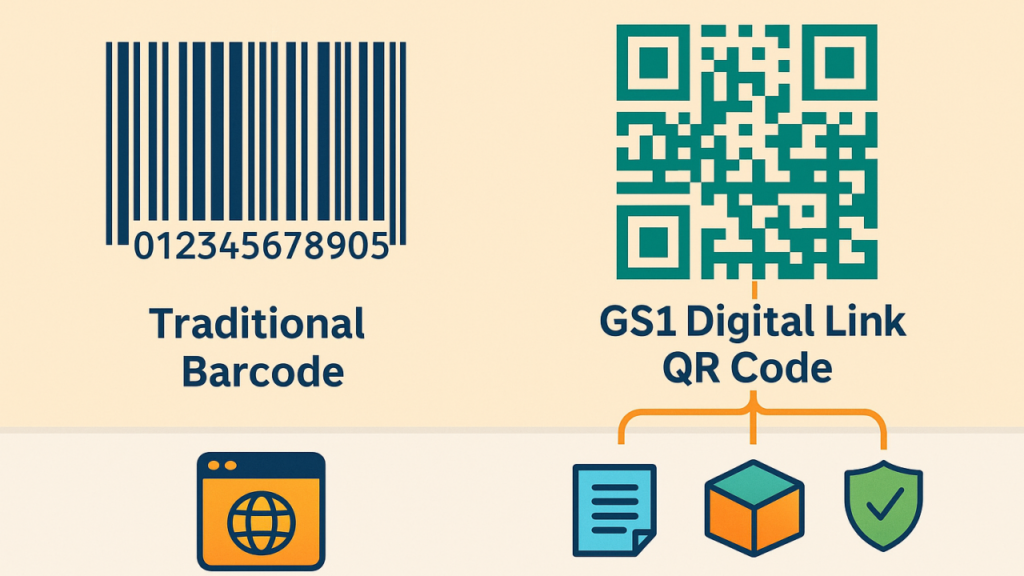
In today’s connected world, bridging the physical and digital realms is essential for businesses and consumers alike. GS1 Digital Link is a revolutionary standard that transforms how products share information through QR codes. Unlike traditional QR codes that often link to a single webpage, GS1 Digital Link QR codes provide a structured, versatile way to connect products to a wealth of digital content, from product details to supply chain data. This article introduces GS1 Digital Link, its purpose, and why it’s a game-changer for industries worldwide.
What is GS1 Digital Link?
GS1 Digital Link is a standard developed by GS1, the global organization behind barcodes and product identification systems. It extends the capabilities of GS1 identifiers—like the Global Trade Item Number (GTIN)—by embedding them into a web-friendly URI (Uniform Resource Identifier). When encoded into a QR code, this URI can direct users to dynamic, context-aware information about a product.
For example, scanning a GS1 Digital Link QR code on a bottle of olive oil might provide consumers with nutritional information, recipe ideas, or authenticity certificates, while supply chain partners might access batch details or logistics data—all from the same code.
How Does It Differ from Traditional QR Codes?
Traditional QR codes typically contain a single URL, directing users to a static webpage. In contrast, GS1 Digital Link QR codes:
- Use standardized GS1 identifiers: They incorporate globally unique product identifiers like GTIN, ensuring consistency across industries.
- Support multiple data points: Beyond the product ID, they can include attributes like lot numbers, expiration dates, or serial numbers.
- Enable dynamic responses: A resolver service interprets the URI and delivers tailored information based on the user’s context (e.g., location, device, or role).
- Are future-proof: The standard aligns with web technologies, making it adaptable to emerging digital trends.
Key Components of GS1 Digital Link
- GS1 Identifiers: These are the building blocks, such as GTIN for products, GLN (Global Location Number) for locations, or SSCC (Serial Shipping Container Code) for logistics units.
- URI Structure: The Digital Link URI follows a specific syntax, e.g., https://example.com/01/01234567890128, where 01 is the GTIN application identifier and 01234567890128 is the GTIN itself.
- Resolver Services: These are web servers that process the URI and return relevant data or redirect to appropriate resources.
- QR Code Encoding: The URI is encoded into a QR code, scannable by any standard QR code reader.
Why GS1 Digital Link Matters
GS1 Digital Link QR codes empower businesses and consumers by:
- Enhancing transparency: Consumers can access detailed product information, such as sourcing or sustainability credentials.
- Streamlining supply chains: Retailers and manufacturers can track products with precision, improving efficiency and reducing errors.
- Boosting engagement: Brands can deliver personalized experiences, like promotions or loyalty programs, directly through a scan.
- Supporting compliance: The standard aligns with regulations requiring traceability, such as in food safety or pharmaceuticals.
Looking Ahead
GS1 Digital Link is more than a QR code—it’s a gateway to a connected ecosystem where products tell their stories. In the next article, we’ll dive into the technical structure of GS1 Digital Link, exploring how its URI syntax and data elements work together to create this powerful standard.
Stay tuned for a deeper look at how GS1 Digital Link is shaping the future of product identification and digital interaction.


